Concrete Repair Budgets: Explain the Scope Before Relying on a Rate
Prepare for a concrete repair budget discussion by separating documented defects, access requirements and specified work from assumptions and unresolved costs.
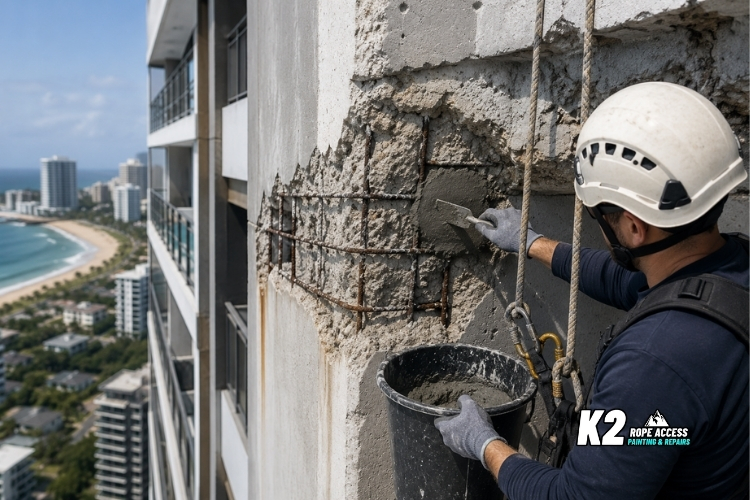
Concrete cancer repair cost depends on the area and depth of the damaged concrete, the condition of the reinforcement, the specified treatment and how the crew can safely reach it. Compare per m² rates on the same repair basis and budget separately for access, engineering and unresolved conditions where the quote excludes them.
Why a generic rate is not a project quote
A rate per m² needs a measurement basis: the concrete patch area, an assumed repair depth and the work included. A coating area is not necessarily a concrete repair quantity. Applying a rate to the area visible in photographs does not establish the project’s total cost.
Keep three levels of pricing information separate:
- Indicative reference: general context without a defined scope for your building.
- Preliminary estimate: an early assessment based on identified information and assumptions, with unresolved items stated.
- Quotation for a defined scope: a price tied to specified locations, quantities, documents, inclusions and conditions, identifying any remaining allowances or exclusions.
Ask which level the supplier is providing. A quotation can still contain provisional quantities; its label alone does not make every cost fixed.
Concrete Balcony Repair Cost for Strata Buildings
For balcony repairs, ask whether the price covers only the spalled slab edge or also work to adjoining waterproofing, finishes or balustrades. Quote comparisons should separate each item and show how access and protection below are priced.
In NSW, the owners corporation generally arranges and pays for repairs to common property. Lot owners are generally responsible for repairs within their lot. Check the strata plan and relevant by-laws before allocating balcony costs. If existing funds cannot cover the common property works, the owners corporation may need to raise a special levy.
Concrete Spalling vs Concrete Cancer: Does It Change the Cost?
Spalling is the visible flaking or breaking away of concrete. Concrete cancer commonly describes deterioration associated with corrosion of embedded steel. The concrete spalling repair cost depends on what the inspection finds beneath the surface, including the depth of unsound concrete and any reinforcement treatment in the specification.
What the known defect scope includes
Start with the locations documented in the available reports: elevation, level, building element and defect reference. Identify whether quantities were measured during an assessment or estimated from limited observations. Scattered balcony-edge repairs may require separate setups or stages, even where their combined area resembles a continuous repair area.
A photograph records appearance; an assessment investigates condition; an agreed repair scope states the work to be priced. Cracking or rust staining does not, by itself, establish the cause, reinforcement condition or full repair extent. Sika Australia’s concrete repair guidance explains the importance of identifying the cause before selecting a repair strategy.
Where specified, identify concrete removal and preparation, reinforcement treatment, repair materials and protective reinstatement. Depth affects the volume removed and reinstated; reinforcement condition can change the specified work. Record their assessment status rather than guessing either input.
Clarify the boundaries of associated work. Membranes, joints, tiles, drainage interfaces, balustrades and make-good painting belong in the budget only where relevant to the agreed repair. State which are included, separately scoped or excluded.
Access, investigation and specification as budget inputs
Access planning needs more than the building’s height. The contractor needs to understand the repair locations, available access-system records, setup constraints and areas occupied below. Entrances, loading zones, tenant operating hours and restrictions on balcony use may affect protection, sequencing and coordination. Include these requirements in the access scope to be priced.
Rope access may suit targeted external repairs, but its suitability needs assessment for the work involved. Another access method may be required. Safe Work Australia’s industrial rope access guidance addresses work scope, site hazards, nearby people and emergency planning. These are practical planning inputs, not reasons to assume one access method will always cost less.
Investigation and specification also need their own scope. An initial condition report, a repair specification and inspections during construction are different services. Identify the documents already available, their dates and revisions, and any further input required before the repair can be priced.
K2RA’s concrete spalling repairs for strata and commercial buildings include high-access remedial delivery aligned with engineering reports and specified scopes. K2RA is a remediation contractor. Engineering assessment, design or inspection services should be identified separately where needed, including who will arrange them and whether their cost is included.
Separate confirmed information from allowances
Make the basis of the budget visible to everyone reviewing it:
- Confirmed information: identified documents, recorded locations and quantities whose assessment or measurement basis is stated.
- Estimates and assumptions: quantities, depths or work conditions used provisionally because evidence is incomplete.
- Allowances: amounts included for stated items whose final extent or cost remains unresolved; record how they will be adjusted.
- Exclusions and open questions: work outside the proposal and information still needed, with responsibility for resolving it.
For example, a report might locate defects on a balcony edge while leaving the extent beneath adjoining finishes unconfirmed. Keep the recorded location separate from any assumed repair quantity and the investigation needed to establish it.
Ask how additional findings will be documented, priced and submitted for approval. An excluded engineering appointment or unpriced investigation is not a zero-cost item. Avoid presenting a preliminary estimate as the complete project budget while those inputs remain unresolved.
What to send with a building-specific enquiry
State whether you need an initial assessment, a preliminary budget discussion or a quotation against an existing specification. Then assemble a short information pack:
- Building address, suburb and state or territory, building use and approximate number of levels.
- Affected elevations, levels and elements, cross-referenced to available photographs, plans or defect schedules.
- Dated photographs already available or obtainable from normal, safe locations, clearly labelled by location.
- Available reports, specifications and drawings, with dates, revisions and any known limits on their coverage.
- Previous repair records and known access or operating restrictions, including occupied areas below the proposed work.
- The decision you need to make, preferred timing and unresolved scope questions.
Use existing records and safe observations. Do not access roofs, climb, lean over edges, approach deteriorated material or disturb concrete to complete the pack. Flag missing information for professional review. Report loose or fallen concrete promptly to building management; do not approach the affected area to obtain photographs.
Can K2RA prepare a firm repair price from photographs?
Photographs can support an initial discussion, but they may leave repair depth, hidden deterioration and access suitability unresolved. Further site assessment or engineering input may be needed before a defined repair scope can be quoted. Ask what the available evidence supports.
Are engineering fees included in a contractor’s price?
Check the stated inclusions. An existing engineer’s report does not mean further investigation, specifications or construction-stage inspections are included. Identify any separate appointment and its deliverables before treating the contractor’s price as the whole budget.
What if deterioration extends beyond the documented area?
The extent may need reassessment and the scope may change. Establish how additional findings and quantities will be recorded, who will review them and how any revised price will be submitted for approval. A provisional allowance should have an explained basis.
Concrete Cancer Repair Cost FAQs
How much does concrete cancer repair cost per m²?
A rate per m² depends on the measured patch area, repair depth and specified treatment. Check how the repair area is measured and whether the rate includes access, protection and making good. These items can materially change the total.
Who pays for concrete cancer repairs in a strata building?
In NSW, the owners corporation generally arranges and pays for repairs to common property. Lot owners are generally responsible for work within their own lot. Check the strata plan and applicable by-laws to confirm responsibility for the affected element.
Is concrete cancer repair covered by a special levy?
A NSW owners corporation may raise a special levy if existing funds cannot cover the cost of common property repairs. Your strata manager can confirm the funding position and what the owners corporation needs to resolve.
Why does rope access reduce repair costs?
Where suitable for targeted external repairs, rope access can reduce the need for full scaffolding and its associated set-up costs. The access method, site constraints and repair scope determine whether it offers a saving for your building.
Send K2RA your building location, photographs obtained safely and available reports to discuss the information needed for the next assessment or pricing step across NSW and ACT. Leave out access codes and occupants’ personal details.

Move from research to the right remedial scope
Related K2RA insights


Need this assessed on an actual building?
Send the building location, photos, defect information and available scope documents. K2RA can review the project context and help determine the next practical step.