Coastal Salt Attack: Managing Concrete Spalling in Sydney Harbour & Coastal NSW
Salt-laden marine air can accelerate reinforcement corrosion, cracking and concrete spalling on coastal buildings. Learn the warning signs, causes and remedial strategies for strata and commercial assets around Sydney Harbour and coastal NSW.
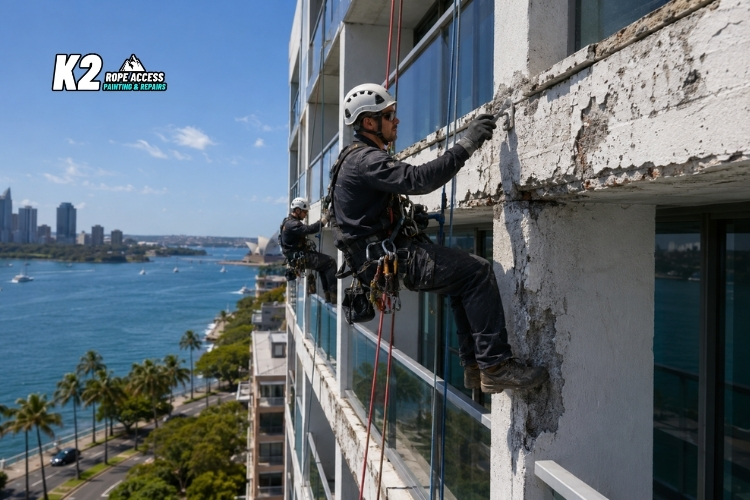
Coastal salt attack can accelerate concrete deterioration on strata, commercial and high-rise buildings around Sydney Harbour and exposed areas of coastal NSW. Marine air, wind-driven rain and salt-laden moisture can gradually penetrate cracks, porous concrete and deteriorated façade finishes, increasing the risk of reinforcement corrosion and concrete spalling.
Once chlorides reach the steel reinforcement inside concrete, corrosion can begin. As the steel corrodes, it expands and places pressure on the surrounding concrete. Over time, this can cause cracking, delamination, rust staining and sections of concrete breaking away from the building.
For building managers, strata committees and asset owners, the visible damage is often only part of the problem. Understanding why the deterioration is occurring is important before deciding how the façade should be repaired.
What Causes Concrete Spalling in Coastal Buildings?
Concrete normally provides a protective environment around the steel reinforcement embedded inside it. However, cracks, failed coatings, insufficient concrete cover, water ingress and ageing façade materials can allow moisture and contaminants to move deeper into the concrete.
In coastal environments, airborne chlorides add another deterioration mechanism. Salt carried from the marine environment can settle on façades, balconies, slab edges, parapets and other exposed concrete surfaces.
If chlorides reach the reinforcement, they can contribute to corrosion. The expanding corrosion products then create internal pressure within the concrete, eventually causing cracking and spalling.
This is why coastal concrete spalling should not automatically be treated as a cosmetic defect. Rust staining or a small cracked area may indicate deterioration extending beyond what is immediately visible.
Why Sydney Harbour Buildings Can Be Particularly Exposed
Waterfront and coastal buildings around Sydney can experience a combination of salt exposure, wind-driven rain, strong UV conditions, façade movement and repeated wetting and drying cycles.
Buildings near Sydney Harbour, coastal suburbs and other exposed areas of NSW may have balconies, slab edges, rendered façades and concrete elements that have been subjected to these conditions for many years.
The actual deterioration mechanism will vary from building to building. Age, original construction quality, reinforcement cover, previous repairs, coating condition, waterproofing and ongoing maintenance can all influence performance.
For NSW buildings already showing cracking, rust stains or loose concrete, K2 Rope Access provides concrete spalling repair services for high-access strata, commercial and managed assets.
Common Signs of Salt-Related Concrete Deterioration
Concrete deterioration can develop gradually, so early warning signs are important. Building managers and owners corporations should pay attention to:
- Rust staining on concrete façades or balcony edges
- Cracks following reinforcement lines
- Flaking, hollow or drummy concrete
- Sections of concrete beginning to delaminate
- Exposed or corroded reinforcement
- Bubbling or failing façade coatings
- Recurring water ingress
- Failed sealants around façade joints
- Previous patch repairs beginning to deteriorate again
Loose concrete at height can also create an immediate safety concern. Areas above entrances, balconies, footpaths, car parks and occupied spaces should be assessed promptly when deterioration is identified.
Why Simple Concrete Patching May Not Be Enough
Applying repair mortar over a visibly damaged area may improve appearance temporarily, but a repair can fail if the underlying deterioration mechanism has not been addressed.
For example, corrosion may continue if chloride-contaminated or unsound concrete remains around the reinforcement. Water ingress through nearby cracks, joints or façade interfaces may also continue feeding the deterioration process.
A more complete remedial approach may involve removing unsound concrete, exposing affected reinforcement, preparing or treating the steel, reinstating the concrete section with an appropriate repair material and restoring the protective façade system.
The exact methodology should be determined by the building condition, engineering requirements and specified repair system.
The Role of Protective Façade Coatings
Protective coatings can form an important part of a broader façade remediation program. Their purpose is not simply to improve appearance. Correctly selected coating systems can help limit moisture and contaminant ingress while protecting repaired concrete from continued environmental exposure.
However, coating deteriorated concrete without completing the necessary repairs first can conceal defects rather than resolve them.
Where concrete deterioration is combined with failed coatings, sealants or water-entry points, a coordinated façade remediation and painting scope may be more appropriate than isolated repainting.
Expansion Joints, Sealants and Water Ingress
Concrete repairs should also be considered in the context of the surrounding façade.
Failed expansion joints, deteriorated sealants and cracks around interfaces can allow moisture to enter behind façade finishes. If those pathways remain open, repaired areas may continue to experience unnecessary water exposure.
For this reason, K2RA may coordinate concrete repairs with expansion joint and façade sealant replacement where these defects form part of the same remedial scope.
How Rope Access Can Support Coastal Concrete Repairs
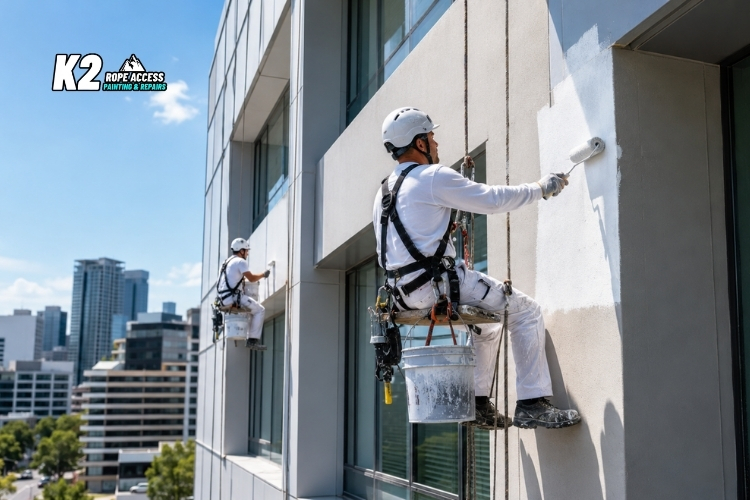
Many concrete defects occur on balcony fronts, slab edges, external columns, façade bands and other areas that are difficult to access from ground level.
Where suitable, rope access can allow technicians to inspect and repair targeted façade areas without relying entirely on full-building scaffolding.
This can be particularly useful for occupied strata and commercial buildings where access planning, resident disruption and maintaining entrances or operational areas are important project considerations.
Rope access is not automatically the correct access method for every repair. Scaffolding, elevated work platforms or other systems may still be required depending on the repair size, location and project methodology.
How to Reduce Future Salt Attack and Concrete Deterioration
Coastal buildings benefit from planned maintenance rather than waiting for visible concrete failure to become severe.
Useful preventative measures can include:
- Regular façade inspections
- Monitoring rust staining and cracking
- Repairing defects before concrete becomes loose
- Maintaining façade coating systems
- Replacing failed sealants and movement joints
- Investigating recurring water ingress
- Maintaining balcony and exposed concrete waterproofing
- Documenting previous repairs and recurring defects
A documented maintenance history can also help strata managers and owners corporations understand how façade deterioration is progressing and plan future capital works more effectively.
When Should a Building Manager Arrange an Assessment?
An assessment should be considered when concrete shows cracking, rust staining, hollow areas, delamination, exposed reinforcement or loose material.
High-access defects deserve particular attention because deterioration may be difficult to inspect closely from ground level and falling concrete can create risks below.
If an engineer or remedial consultant has already prepared a defect report, photographs or repair specification, those documents can also help define the required scope and access methodology.
Concrete Spalling Repairs for Sydney and Coastal NSW Buildings
Salt exposure is only one potential contributor to concrete deterioration, but it is an important consideration for buildings around Sydney Harbour and other coastal environments in NSW.
Effective remediation should address the condition of the concrete, reinforcement, surrounding façade and moisture-entry pathways rather than treating only the visible surface damage.
K2 Rope Access supports strata, commercial and managed buildings across Sydney and NSW with high-access concrete repairs, façade remediation, protective coating renewal and related exterior maintenance.
If your building has rust staining, cracking, loose concrete or an existing engineer’s report, send K2RA the building location, photographs and available documentation to discuss the appropriate next step.
Move from research to the right remedial scope
Related K2RA insights


Need this assessed on an actual building?
Send the building location, photos, defect information and available scope documents. K2RA can review the project context and help determine the next practical step.