Concrete Crack Repair Materials: What Commercial Buildings Need for Long-Term Façade Protection
Concrete crack repair materials play a major role in long-term façade protection for commercial buildings. This article explains epoxy injection, sealants, repair mortars, waterproofing and protective systems used in professional concrete façade repair.
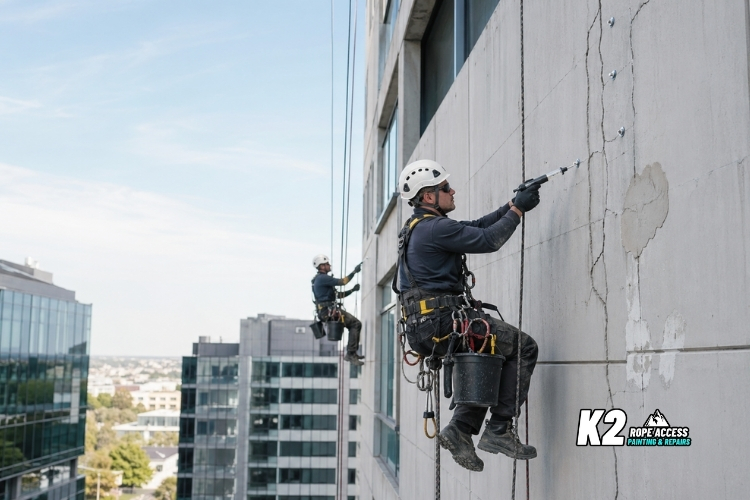
Concrete Crack Repair Materials: What Commercial Buildings Need for Long-Term Façade Protection is a practical question for strata managers, facilities teams and commercial asset owners trying to prevent small façade defects from becoming expensive building-wide problems.
Concrete crack repair materials are not all designed for the same purpose. A fine shrinkage crack, an active movement joint, a water-ingress point and a structurally significant crack each require a different repair method. Choosing the wrong product can make a wall look patched for a short time, while the underlying issue continues to spread behind the coating system.
For commercial building crack repair, the goal should never be cosmetic repair alone. The right system should restore durability, reduce moisture entry and support long-term concrete protection across the façade.
Why material selection matters in commercial facade repair
Commercial facade repair needs to account for exposure, building height, movement, moisture and the condition of the existing concrete. On mid-rise and high-rise buildings across NSW and the ACT, façades are exposed to wind-driven rain, UV, coastal air, thermal movement and ongoing building vibration.
A small external crack can allow water to enter the concrete substrate. Once moisture reaches reinforcement steel, corrosion can expand inside the concrete, contributing to cracking, delamination and concrete spalling repair requirements.
That is why professional concrete facade restoration usually starts with proper inspection, not simply choosing the best concrete patch for commercial buildings from a shelf. The material must match the cause, location and severity of the defect.
If cracking is already linked with delamination or spalling, K2RA can assess the façade and recommend a more complete approach through its commercial concrete spalling repair services.
Common concrete crack repair materials used on commercial buildings
Epoxy injection for concrete cracks
Epoxy injection for concrete cracks is often used when a crack needs to be structurally bonded. It can restore continuity in certain types of concrete cracks, particularly where the crack is stable and dry enough for the resin to bond correctly.
However, epoxy is rigid. If the crack is still moving, or if moisture remains active, epoxy may not be the right solution on its own. In those cases, other waterproofing concrete cracks methods may be required before any coating or finishing system is applied.
Polyurethane concrete sealants for movement and water control
Polyurethane concrete sealants are commonly used where movement is expected. They are flexible, durable and suitable for many exterior concrete wall repair situations, especially around joints, façade gaps and areas exposed to weather.
For commercial façades, sealant performance depends heavily on correct preparation, joint sizing, backing rod installation and adhesion. Poorly applied sealants can fail early, allowing water to return behind the façade coating.
Structural concrete repair products
Structural concrete repair products are used where the concrete has lost strength, cover or integrity. These products may include repair mortars, corrosion protection systems, bonding agents and reinstatement materials designed for larger remedial work.
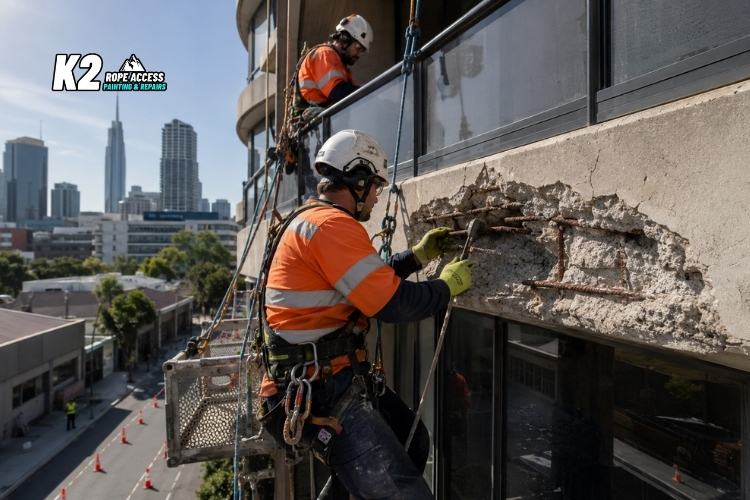
In concrete spalling repair, the process may involve removing loose concrete, treating exposed reinforcement, rebuilding the damaged section and applying compatible protective coatings. This is very different from a quick surface patch.
Concrete patching compounds and repair mortars
When people search for the best concrete patch for commercial buildings, they are often looking for a simple product comparison. In reality, the best option depends on whether the repair is cosmetic, protective or structural.
A patching compound used on a low-risk wall may not be suitable for a high-rise façade exposed to water ingress and movement. Commercial masonry repair and concrete repairs should be selected based on substrate condition, exposure level and expected service life.
Waterproofing concrete cracks before the damage spreads
Waterproofing concrete cracks is critical when cracks are allowing moisture into the building envelope. Water can travel behind coatings, through joints and into adjacent areas, making the visible crack only one part of a larger issue.
A good repair strategy may include crack sealing, membrane coatings, elastomeric coatings, joint replacement and concrete surface protection solutions. These systems help reduce future moisture ingress and extend the life of the façade.
For strata or commercial buildings dealing with recurring cracking, water entry or visible concrete deterioration, it is worth speaking with a specialist before the problem becomes a larger capital works issue. K2RA can help with rope access concrete repair and façade remediation designed for difficult-access buildings.
How repair materials fit into long-term building facade maintenance
Building facade maintenance is not just about fixing defects as they appear. A strong maintenance plan looks at why cracking is happening, how exposed the building is, and whether other systems are starting to fail.
For example, cracking may be connected to failed expansion joints, ageing sealants, poor drainage, coating breakdown or reinforcement corrosion. Treating only the visible crack may leave the building exposed to the same problem again.
Long-term concrete protection usually requires a layered approach:
- identifying the cause of the crack
- selecting compatible repair materials
- restoring damaged concrete properly
- sealing or waterproofing vulnerable areas
- applying protective façade coatings where required
- monitoring high-risk sections over time
This is especially important for strata buildings, commercial assets and government properties where façade access, disruption and safety compliance all need to be managed carefully.
Choosing the right concrete crack repair system for a commercial façade
The right repair system should answer three questions: is the crack structural, is water entering, and is the crack still moving?
If the crack is stable and structural bonding is needed, epoxy injection may be appropriate. If movement or water ingress is present, flexible sealants, membranes or waterproofing systems may be more suitable. If the concrete has started to break away, structural concrete repair products and proper spalling repair methods may be required.
This is why commercial facade repair should be assessed as part of the whole façade, not as a small isolated defect. A technically sound repair protects the building, improves appearance and reduces the risk of repeated failures.
If your building has cracking, spalling, failed sealants or moisture-related façade defects, you can request practical advice through K2RA’s commercial façade repair contact team.
Final thoughts on concrete crack repair materials
Concrete crack repair materials are only effective when they are matched to the building, the defect and the long-term performance goal. For commercial buildings, the priority should be durable remediation, not quick patching.
A proper repair may involve epoxy injection, polyurethane sealants, structural repair mortars, waterproofing systems and protective coatings. The best result comes from understanding how these materials work together as part of a complete façade maintenance strategy.
For strata, commercial and government buildings across NSW and the ACT, early action can reduce future repair costs and help preserve façade safety, durability and presentation. For a more complete assessment, K2RA provides specialist concrete spalling repair and façade remediation for high-access buildings.
Move from research to the right remedial scope
Related K2RA insights

Need this assessed on an actual building?
Send the building location, photos, defect information and available scope documents. K2RA can review the project context and help determine the next practical step.